


 View, manage and change your tickets.
 Follow us in Facebook


For business
Buying a ticket
Buying a ticket without entering into a contract
Are you a representative of a company and would like to buy tickets from our e-service so that your company’s data is included in the invoice, but you do not wish to enter into a contract with us or create an account for your company? If so, you can buy tickets by paying for them immediately using a bank link, credit card or mobile payment and entering the details of the company on the invoice attached to the ticket.
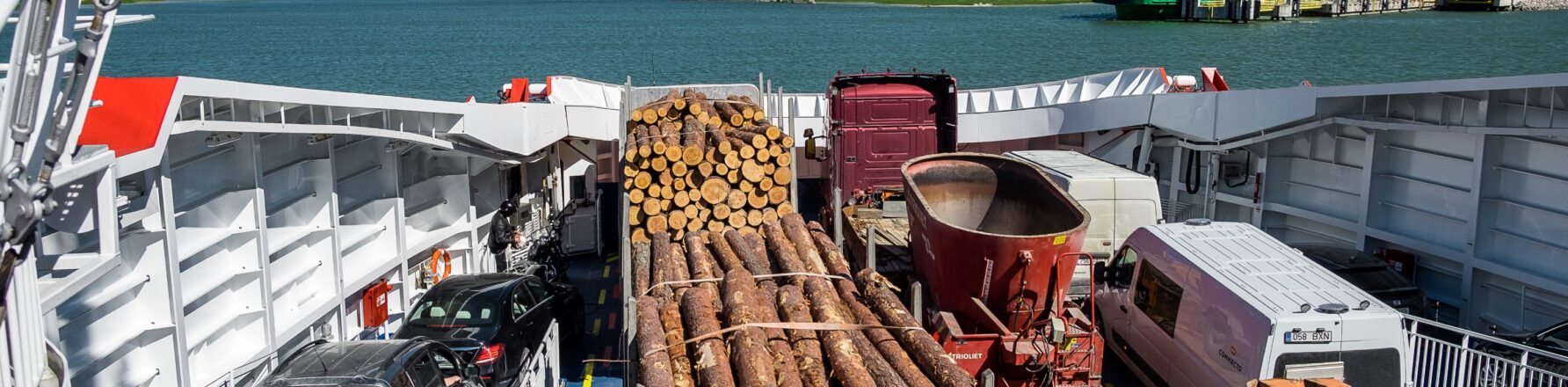
Large, heavy and special vehicles
The vertical clearance on our ferries is 4.5 m and the width of the corridor at this height is 8 m. The maximum weight of a vehicle may be 44 t and the maximum axle load 13 t.
- A large vehicle is wider than 2.6 m and/or higher than 4.0 m.
- A heavy vehicle has an axle load of over 11.5 t or a maximum mass of over 44 t.
- A special vehicle is a large or heavy vehicle with at least one of its dimensions or weight exceeding the maximum dimensions, mass or axle load allowed in Estonia.
The transportation of a large or heavy vehicle must be booked at least two working days before the requested departure. You can do this by by contacting our customer support on 618 1310 or by e-mailing [email protected].
Dangerous goods
Dangerous substances are transported on our ferries according to the International Maritime Dangerous Goods Code (IMDG Code) adopted by the International Maritime Organization (IMO). Goods are considered dangerous if they include dangerous substances. You have to notify us of this when making your booking.
According to the rules, dangerous goods are transported on special departures marked in the schedule. Due to safety requirements, the total number of passengers may not exceed one person per metre of the total length of the ferry on such trips.
- The number of passengers allowed on the ferry differs from ferry to ferry.
- In the case of departures for the transportation of dangerous goods, the advance sale of tickets remains open until the upper limit of passengers is reached.
Transporting hay
Hay is a highly flammable material (UN 1327, class 4.1) and the transportation of hay loads on ferries must therefore be in accordance with the requirements of the IMDG Code.
Review the transport instructions for highly flammable goods.
- The hay load must be secured according to requirements.
- If the load is carried on an open transport unit, it must be covered completely with a load cover. The load must be covered from the top and on the sides.
- No declaration or advance notification is needed.
- Upon arrival at the port, hay carriers are obliged to notify the shore crew and the port operatives.
- The captain of the ferry has the right to refuse to board a vehicle carrying a hay load if the load has not been covered or secured or is loose, damp, wet or oily.
Vehicles transporting live animals
Live animals are generally transported on special trips that are also marked in the schedule. The general requirements of the vehicle and the transporting of the animals are laid down in the Animal Protection Act.